Corporate

best ai seo agency in toronto

How to Choose the Best AI SEO Agency in Toronto (2026 Buyer’s Guide)

Businesses searching for the best AI SEO agency in Toronto are no longer looking for traditional SEO alone. AI-powered search is changing how companies compete online, and brands now need visibility across Google Search, AI Overviews, ChatGPT, Gemini, Perplexity, and conversational AI systems. Traditional SEO alone is no longer enough. Brands now need visibility across: Google Search AI Overviews ChatGPT Gemini Perplexity Conversational AI systems As a result, many companies are now searching for the best AI SEO agency in Toronto — not just another digital marketing provider. But with so many agencies suddenly claiming to offer “AI SEO,” how do you know which ones actually understand the future of search? This guide breaks down: What an AI SEO agency actually does What Canadian brands should look for Questions to ask before hiring Why AI search optimization is becoming critical in 2026 If you’re new to the topic, we recommend starting with: The Ultimate Guide to AI SEO in Canada (2026 Edition) AI SEO FAQ: 25 Most Frequently Asked Questions About AI SEO AI SEO Agency vs Traditional SEO Agency: What Canadian Brands Must Know Why Traditional SEO Agencies Are Struggling in the AI Era For years, SEO focused primarily on: Rankings Backlinks Keywords Google traffic While those fundamentals still matter, search itself is evolving rapidly. Users are increasingly discovering brands through: AI-generated summaries Conversational search LLM recommendations AI assistants like ChatGPT and Gemini Ongoing AI search and SEO industry analysis continues to show how rapidly conversational discovery is changing user behaviour, content visibility, and search traffic patterns. Google’s AI Overviews alone have already changed how many users interact with search results. Instead of clicking multiple links, users are increasingly consuming summarized answers directly inside search experiences. Businesses monitoring the evolution of Google AI Overviews are already seeing major shifts in visibility, click behaviour, and informational search traffic. Industry analysts tracking AI search market evolution increasingly believe conversational search behaviour will continue reshaping how brands acquire visibility online. At the same time, platforms like ChatGPT and Perplexity are becoming discovery engines for: SaaS tools Agencies Service providers B2B software Professional services This shift means brands now need visibility beyond traditional rankings. That’s where AI SEO agencies enter the picture. Businesses searching for the best AI SEO agency in Toronto are increasingly looking for agencies that understand both traditional SEO and AI-powered discovery systems. The Best AI SEO Agency in Toronto May Not Be the Biggest Agency Many traditional SEO agencies are now retrofitting AI terminology onto outdated SEO systems. However, AI-powered search is changing optimization fundamentally. The agencies most likely to succeed in AI search may not necessarily be the largest agencies or the ones producing the highest volume of content. Instead, the strongest AI SEO agencies increasingly focus on: Semantic authority Conversational discovery AI visibility systems Entity recognition Structured expertise Long-term trust signals As AI-powered search evolves, businesses will likely benefit more from agencies that deeply understand AI discovery behaviour rather than agencies still relying only on legacy SEO tactics. This is especially important in Toronto’s highly competitive SaaS and B2B ecosystem, where authority and visibility advantages compound quickly. What the Best AI SEO Agency in Toronto Actually Does The Best AI SEO Agency in Toronto Focuses on AI Visibility — Not Just Rankings One of the biggest misconceptions right now is that AI SEO simply means “using AI tools for content.” That’s not what serious AI SEO agencies do. A true AI SEO agency helps brands improve visibility across: Search engines AI search environments LLM-generated answers Conversational discovery systems Recent reporting around AI search trends and conversational discovery also highlights how quickly AI-powered search behaviour is evolving across industries. This includes several layers of optimization. Entity Optimization AI systems rely heavily on entities — recognizable concepts tied to brands, people, industries, and expertise. Strong AI SEO agencies help businesses: Establish clear brand associations Improve topical relevance Strengthen semantic relationships Build authority around specific subjects This improves how AI systems understand and reference your business. AI Search Visibility Modern AI SEO involves optimizing for: ChatGPT visibility Gemini visibility AI Overviews Perplexity citations Conversational search experiences This is often referred to as: LLM SEO AI search optimization GEO (Generative Engine Optimization) Recent Generative Engine Optimization research has further reinforced the growing importance of AI-readable authority signals and semantic relevance. The goal is no longer just ranking pages. It’s becoming part of AI-generated answers. In many cases, future visibility may depend less on ranking #1 traditionally — and more on whether AI systems choose to reference and trust your brand at all. Semantic SEO & Topic Authority AI systems evaluate: Depth of expertise Topic relationships Contextual authority Content ecosystems Strong agencies build: Comprehensive topic clusters Structured semantic coverage Educational authority content Conversational search relevance This is particularly important for B2B and SaaS companies. Businesses comparing an AI SEO Agency vs Traditional SEO Agency are increasingly realizing that AI-powered discovery requires deeper semantic optimization than rankings alone. Structured Authority & Trust Signals AI systems increasingly prioritize: Credibility Structured information Consistent expertise Clear positioning High-trust sources Modern AI SEO, therefore includes: Schema optimization Structured content architecture Brand consistency Trust-building content systems 7 Things to Look for in the Best AI SEO Agency in Toronto Not every agency offering “AI SEO” actually understands AI search. Here’s what Canadian businesses should evaluate carefully. 1. Proven SaaS & B2B Experience AI search optimization is especially important for: SaaS platforms B2B companies High-consideration services Look for agencies with: Technical understanding Long sales-cycle experience Complex buyer journey expertise Content-led growth experience B2B AI SEO is very different from local SEO alone. 2. Real AI Search Expertise Ask whether the agency understands: ChatGPT visibility AI Overviews LLM optimization Conversational search GEO (Generative Engine Optimization) Many agencies still only optimize for traditional Google rankings. The future requires both. 3. Strong Technical SEO Foundations AI search still depends heavily on technical clarity. Your agency should understand: Crawlability Site structure Structured data Internal linking Performance optimization Semantic architecture Without strong technical

How to Choose the Best AI SEO Agency in Toronto (2026 Buyer’s Guide) Read More »
chatgpt ads Are Now Rolling Out Across Canada What Businesses Need to Know

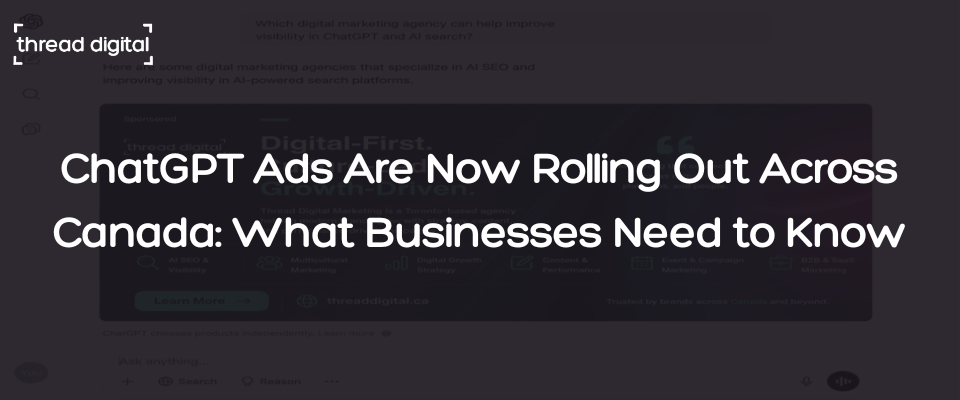
ChatGPT Ads Are Now Rolling Out Across Canada: What Businesses Need to Know

The ChatGPT Ads rollout in Canada is officially beginning — and the shift could reshape how Canadian businesses compete for visibility online. AI-powered search is evolving rapidly, and conversational discovery is beginning to change how users research products, compare providers, and make purchasing decisions. For Canadian businesses, this is not simply another advertising update. It represents a major shift in how people: Discover brands Compare services Research products Make purchasing decisions online And importantly, it creates a new opportunity for businesses that move early. If you’re unfamiliar with how ChatGPT advertising works, we recommend first reading our complete guide: Are ChatGPT Ads Available in Canada? What Brands Need to Know in 2026 Why the ChatGPT Ads Rollout in Canada Matters For years, digital advertising has revolved around: Google Search Social media platforms Display networks Traditional PPC campaigns But AI tools are changing how users interact with information. Instead of searching through pages of results, users are increasingly: Asking AI tools direct questions Requesting recommendations Comparing providers conversationally Seeking summarized answers instantly Now, advertising is becoming part of those interactions. This means brands can potentially appear: During research conversations During recommendation prompts Before users ever visit Google Inside AI-assisted buying journeys That’s a major shift in digital marketing behaviour. What Are ChatGPT Ads? ChatGPT Ads are contextual advertising placements that appear alongside conversational AI responses. Unlike traditional banner advertising, these ads are designed to: Match user intent Align with conversational context Feel useful rather than interruptive Appear naturally within AI-powered discovery flows According to OpenAI’s rollout approach: Ads are clearly labeled Ads remain separate from AI-generated answers Paid ChatGPT tiers remain ad-free Targeting focuses on conversational intent rather than personal profile data This creates an entirely different advertising environment compared to traditional search. For additional context, marketers can review OpenAI’s advertising policies and broader AI search and advertising trends shaping the industry. What’s Rolling Out With the ChatGPT Ads Rollout in Canada Early ChatGPT Ads Rollout in Canada Inventory Remains Limited As of mid-2026, Canadian users and advertisers are beginning to see: Sponsored placements inside ChatGPT’s Free and Go tiers Early conversational ad inventory Initial advertiser onboarding AI-native advertising experiments across multiple industries However, rollout remains gradual. Not all users will immediately see ads, and advertiser access is still evolving. OpenAI appears focused on carefully scaling inventory while protecting user trust and experience. This mirrors how major digital advertising platforms historically expanded during early launch phases. Canadian B2B software companies, financial firms, SaaS providers, and professional service businesses may be among the earliest industries to benefit from conversational advertising environments. Why Businesses Should Prepare for the ChatGPT Ads Rollout in Canada Many businesses will wait until AI advertising becomes mainstream. That’s likely a mistake. Historically, the brands that benefit most from emerging advertising channels are the ones that: Learn early Build systems early Establish authority before competition intensifies That pattern applied to: Google Ads Facebook Ads YouTube Ads TikTok advertising And it may apply to AI search advertising as well. Early adopters gain: Lower competition Faster learning curves Better positioning Stronger authority signals In other words: This is not just a media-buying opportunity. It’s a visibility opportunity. AI Advertising May Reward Trust More Than Click Volume Traditional digital advertising often rewards whoever bids the highest. AI-powered discovery environments may evolve differently. As conversational AI systems become more sophisticated, contextual trust and topical authority could become increasingly important alongside advertising spend. That means brands with: strong entity recognition trusted content ecosystems clear expertise signals strong topical authority may gain advantages beyond traditional PPC mechanics. The businesses AI systems understand best may ultimately outperform businesses relying only on ad budgets. ChatGPT Ads Depend on AI SEO AI Visibility Will Influence the ChatGPT Ads Rollout in Canada One of the biggest misconceptions right now is that ChatGPT Ads are simply another PPC platform. They’re not. AI-powered advertising depends heavily on whether AI systems already understand your brand. That’s where AI SEO becomes critical. Strong AI SEO helps: Establish brand entities Improve topical authority Increase AI discoverability Strengthen contextual understanding Improve future ad relevance The brands most likely to succeed with ChatGPT Ads are the ones that already: Publish authoritative content Build semantic topic coverage Demonstrate expertise Create AI-readable websites This is why AI SEO and AI advertising strategy are becoming increasingly connected. Businesses investing early in AI Search Optimization & LLM Visibility may gain a significant long-term advantage as conversational advertising expands. What Industries Could Benefit Most from ChatGPT Ads rollout in Canada? ChatGPT Ads may become especially valuable for industries where users: Research extensively Compare multiple providers Need explanations before purchasing This includes: SaaS and B2B companies Professional services Finance and insurance Technology platforms Education and training AI-enabled businesses Conversational advertising environments are particularly powerful for high-consideration purchases. For example, a Canadian software company could eventually appear during prompts such as: “What’s the best CRM platform for small businesses in Canada?” Similarly, agencies, consultants, law firms, and financial providers may increasingly appear during AI-driven recommendation and comparison conversations. How AI Search Is Changing Customer Behaviour Traditional search behaviour looked like this: Search a keyword Browse multiple websites Compare options manually Make a decision AI search increasingly compresses this journey. Users now ask: “What’s the best AI SEO agency in Canada?” “Which software should I use?” “What platform is best for my business?” “How do I improve AI visibility?” And AI tools increasingly provide: Summaries Recommendations Context Comparative guidance This fundamentally changes how businesses compete for attention. Brands investing in Conversational Search Marketing are already adapting content strategies around these behavioural shifts. What Canadian Brands Should Do Next with ChatGPT Ads rollout in Canada 1. Invest in AI SEO Ensure your brand is: AI-readable Entity-optimized Structured properly Topically authoritative This improves visibility inside AI-generated answers and future advertising systems. Brands can start by strengthening their AI SEO Agency strategy and improving semantic topic authority. 2. Build Conversational Content Future AI discovery depends heavily on: Questions Answers Intent mapping Natural language relevance Brands should

ChatGPT Ads Are Now Rolling Out Across Canada: What Businesses Need to Know Read More »

AI Search Optimization for SaaS

AI Search Optimization for SaaS and B2B Companies

AI Search Optimization is quickly becoming a must-have growth lever for SaaS and B2B companies. Not because “AI is the future,” but because buyer research has changed. In 2026, prospects are increasingly getting answers, shortlists, and recommendations inside AI interfaces before they ever click through to a website. If your SaaS product isn’t showing up in those AI-generated answers, you’re missing the moment where criteria gets formed and vendors get shortlisted. This article is a supporting guide to help SaaS and B2B teams understand what to do differently, what matters most, and how to execute without turning it into a massive new program. If you want the full foundation first, start with Thread Digital’s primary guide on AI Search Optimization: AI Search Optimization. Why AI Search Optimization is different for SaaS and B2B SaaS and B2B buying journeys are not simple. They involve multiple stakeholders, longer decision cycles, and higher perceived risk. That creates an AI search dynamic that looks different from ecommerce or local services. In SaaS and B2B, AI tools are often used for: category discovery and definition early-stage vendor shortlisting comparison and evaluation risk and trust checks “how do we implement this?” planning These are not single-query moments. They are multi-step conversations. That’s why being included in AI-generated answers often matters as much as ranking a page on Google. Where AI shows up in the SaaS buyer journey in 2026 Here’s the practical way to think about it: AI shows up earlier, and it stays involved longer. Stage 1: category framing Prompts look like: What is the best HRIS for mid-market companies? What does an AI SEO agency actually do? What’s the difference between CDP and CRM? If AI defines your category in a way that doesn’t include you, you start behind. Stage 2: criteria formation Prompts look like: What should I look for when evaluating a payroll vendor? What are common migration risks? How do I compare pricing models? This is where buyers build a mental checklist. Your content needs to be the source material AI pulls from. Stage 3: shortlisting Prompts look like: Top alternatives to X Best options for Y in Canada Compare Vendor A vs Vendor B This is where LLM visibility directly impacts the pipeline. If you’re not included, you’re not considered. Stage 4: risk and trust validation Prompts look like: Is this vendor compliant? Where is data stored? Is this product secure for enterprise use? AI Search Optimization is not only about content. It’s also about trust signals being clear and easy to retrieve. What SaaS Teams Should Optimize for in AI Search Optimization for SaaS and B2B The goal isn’t to “rank in ChatGPT.” The goal is to be: understood as a clear entity associated with the right topics trusted as a credible source easy to extract and cite For SaaS and B2B, that means focusing on four major areas: entity clarity topical authority content structure built for extraction trust, proof, and third-party signals Entity clarity in AI Search Optimization for SaaS and B2B SaaS websites often suffer from one big problem: unclear positioning. AI systems struggle when your site says: “We empower teams to drive outcomes” “A modern platform for growth” “The future of work, reimagined” A SaaS company that wants LLM visibility needs to be explicit: what the product is what category it belongs to who it’s for what geography it serves what it integrates with what makes it different What to fix first on your SaaS website If you can only do five things: Write a plain-language positioning statement on the homepage and About page. Use consistent category labels across the site (don’t alternate between five different terms). Add a product overview page that explains what the platform does in concrete terms. Make your ideal customer explicit (industry, company size, use case). Add a clear “where we operate” signal if you serve Canada or other specific markets. Canada-first note: if you sell into Canada, say it directly. AI systems often default to US assumptions unless Canada is explicit. Topical authority in AI Search Optimization for SaaS and B2B questions Topical authority isn’t about publishing more. It’s about publishing the right coverage. For SaaS and B2B, your best-performing AI search content usually maps to: problems buyers are trying to solve comparisons they want to make implementation questions they need answered objections that stall deals A practical cluster model for SaaS Pick one commercial topic and build: one anchor guide (deep and defensible) 5–10 cluster posts that answer related buyer questions one comparison page (even if it’s “how to compare,” not “us vs them”) one implementation or onboarding explainer Example cluster for “AI Search Optimization for SaaS”: Anchor: AI Search Optimization for SaaS and B2B Cluster: How to improve LLM visibility for B2B brands Cluster: What AI search results mean for SEO strategy in 2026 Cluster: How to structure SaaS content for extraction and citations Cluster: Measuring visibility in AI-generated answers Cluster: AI SEO vs AI Search Optimization If you want the baseline architecture, Thread Digital’s AI SEO in Canada guide can be a helpful internal reference: AI SEO in Canada guide. Content designed for extraction in AI Search Optimization for SaaS and B2B AI tools pull and summarize content in chunks. That means structure is strategy. What “extraction-ready” SaaS content looks like clear H2s and H3s that match real questions definitions in the first 1–2 sentences of each section bullet lists for steps, criteria, and tradeoffs short paragraphs (2–4 lines) simple comparisons and “best for / not for” language FAQs that address the questions buyers actually ask in sales calls Where SaaS teams can apply this immediately Start with pages that already have demand: your highest-traffic blog posts your comparison pages your product pages your pricing page FAQs your integration pages your “security” and “privacy” pages Then rewrite them for clarity and extractability rather than keyword density. If your team needs alignment on what AI SEO means and what it doesn’t, Thread Digital’s AI SEO FAQ is

AI Search Optimization for SaaS and B2B Companies Read More »

Thread Digital – A Digital-First Marketing Agency

Some agencies talk. We get to work. Thread Digital was built on one simple belief: great ideas mean nothing without flawless execution. We’re a marketing agency that thrives in the trenches — building, launching, optimizing, and scaling with sleeves rolled up and timelines tight. What do we do? We help brands grow — not in a vague, buzzword-filled way, but in real, tangible numbers. That could mean filling every seat at a major concert through paid social, or building a B2B funnel that delivers a 600% lift in qualified leads. We do what’s required to hit the goal — and we don’t stop at strategy decks. Thread Digital – Core Areas We focus on three core areas: Multicultural Strategy Reaching diverse audiences takes more than translation — it takes cultural fluency. We help brands understand how to show up with authenticity in communities that are often underserved, misrepresented, or simply overlooked. From insights and creative direction to digital execution, we ensure your brand connects — for real. Digital Growth You can’t grow if you can’t convert. Our digital growth work includes funnel design, paid media, SEO, landing pages, email, and everything in between. We’ve helped SaaS companies build million-dollar pipelines and nonprofits 4x their online engagement — all through tight targeting, smart messaging, and zero wasted spend. Event Marketing Big shows, small launches, high-stakes activations — we bring the audience. We build hype where it matters, with the creative and paid strategy to make sure people show up. Whether it’s a major artist’s concert or a political campaign event, our job is simple: get attention, drive action, fill the room. Real Work. Real Results. We’ve helped emerging brands punch above their weight. We’ve helped established ones move faster and go deeper. We’re equally comfortable in Google Ads dashboards as we are in creative brainstorms. And we’re not in this to win awards — we’re in this to win market share. This is Thread Digital. Strategy, meet execution. Want to work together? Contact us to bring clarity, momentum, and results to your next campaign.

Thread Digital – A Digital-First Marketing Agency Read More »